
Traditional OCR and rule-based systems were never built for the fluid reality of modern document processing. Any variation in layout, language, or format can break their pipelines — demanding manual fixes and endless validation loops. Today’s advanced extraction frameworks leverage LLMs ,VLMs , and context engineering to create fully adaptive pipelines. This new architecture allows AI to interpret document content semantically rather than structurally, delivering consistent, human-level accuracy across variable formats while drastically reducing setup and maintenance time.
Key takeaways:
99%+ accuracy — AI-powered extraction tools now outperform legacy OCR systems stuck at 60–80% reliability.
Days, not months — modern pipelines go live in a matter of days instead of endless setup cycles.
No more templates — intelligent models adapt automatically to any document layout or format.
Built for real-world complexity — even handwritten notes, dense layouts, and degraded scans are handled with precision.
The new standard — Retab delivers continuous learning, integrated evaluation, and full automation for production-ready document processing.
How “state of the art” document processing Software works ?
At its core, state-of-the-art data extraction software uses AI to turn unstructured documents into structured, usable data — automatically. Instead of manually reviewing PDFs or scans, the system is capable of understanding the content, the context, and the relationships within each document.
The process starts with automated preprocessing, where files are cleaned and standardized so the AI can read nearly any format — from invoices to contracts. A schema then defines exactly what information should be extracted and how it should be structured.
Unlike traditional or rule-based tools, modern systems reason through the content using LLMs and VLMs, and compare multiple interpretations through a consensus engine to ensure the most accurate output. Each run is also evaluated and refined, allowing continuous improvement over time.
The result is a production-ready, end-to-end pipeline that processes thousands of documents with speed, accuracy, and minimal human effort — something far from guaranteed in most other software.
Benchmarking the Next Generation of Data Extraction Platforms :
Our evaluation focused on the technical architecture, scalability, and real-world reliability of modern data extraction systems. Each platform was assessed on its ability to process unstructured data, handle layout variability, and deploy at scale without extensive manual configuration.
We prioritized AI-native solutions that integrate Large Language Models (LLMs) and Vision-Language Models (VLMs) for contextual understanding, outperforming retrofitted OCR systems. Key criteria included schema-driven extraction, consensus-based validation, evaluation mechanisms, and continuous learning to ensure lasting accuracy and adaptability.
Additional factors such as API quality, integration capabilities, and support for multiple document formats were also considered, along with proven adoption in finance, healthcare, and logistics, where precision is critical.
Industry analysts increasingly recognize the shift toward AI-first Intelligent Document Processing (IDP) platforms — purpose-built for automation and scalability. Our assessment aligns with this evolution, highlighting Retab as a platform designed natively around modern AI principles rather than legacy OCR retrofits.
1. Best Overall: Retab
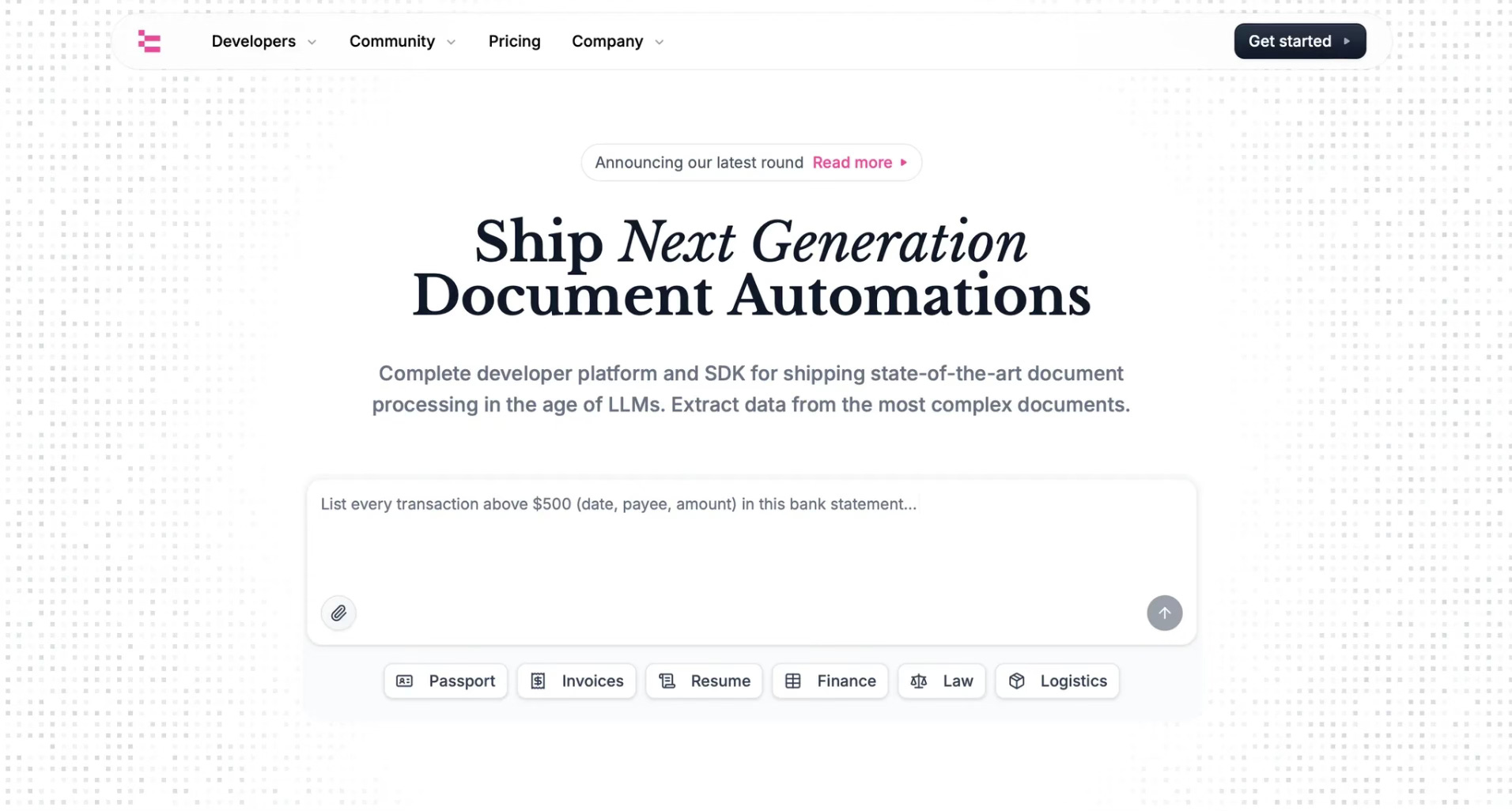
Retab is a complete, AI-native infrastructure that automates document processing from end to end — transforming raw, unstructured files into structured, production-ready data with accuracy levels consistently above 99%.
Its intelligent preprocessing engine automatically detects, cleans, and standardizes any document type — from PDFs and scanned forms to images and emails — ensuring that every input is perfectly prepared for analysis. Once normalized, a schema-driven approach defines what information needs to be extracted and how it should be organized, producing clear, coherent outputs that integrate seamlessly with enterprise systems.
Beyond simple extraction, the platform introduces a powerful reasoning layer through its consensus engine, comparing multiple model outputs to identify and validate the most reliable result. Combined with integrated evaluation and benchmarking tools, this process enables rapid iteration, continuous performance improvement, and measurable gains in precision with every dataset processed.
Designed for real-world complexity, it accurately interprets documents containing tables, handwritten notes, signatures, or degraded scans — areas where legacy OCR systems typically fail.
Its flexibility allows organizations in finance, legal, healthcare, and logistics to automate document-heavy workflows, eliminate manual review, and accelerate operations with confidence.
Deployed in days rather than months, Retab delivers a production-ready, self-improving pipeline that continuously learns, refines, and scales. The result goes beyond automation — it’s an intelligent, evolving system that turns document chaos into structured clarity, one iteration at a time.
2. Azure Ai
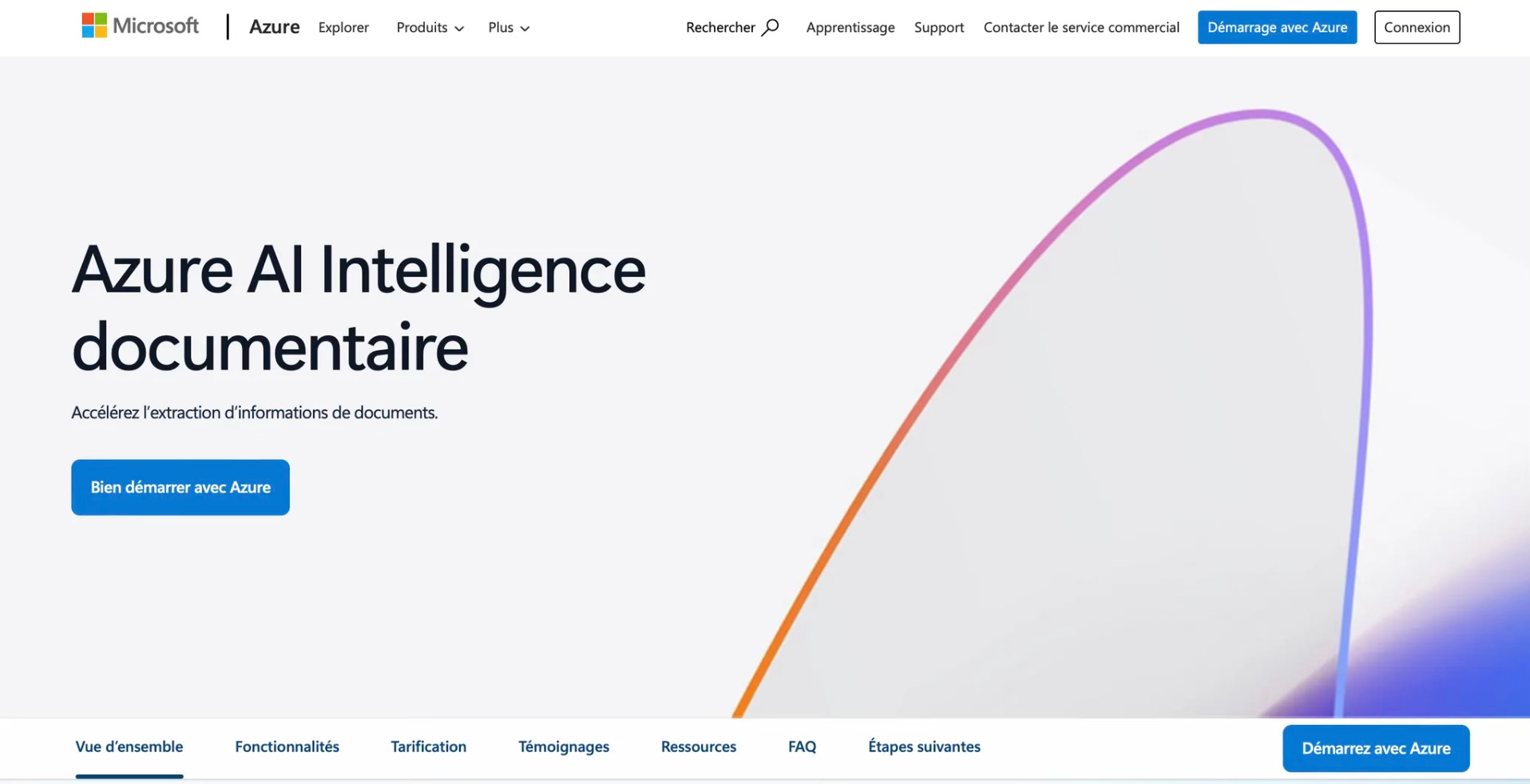
Microsoft’s Azure AI Document Intelligence provides cloud-based OCR and document processing capabilities to convert unstructured documents — such as PDFs, images, and forms — into structured, machine-readable data. The platform uses AI-driven text recognition and document understanding models to extract handwritten and printed text, tables, and key-value pairs across multiple languages.
What they offer: OCR technology enhanced with AI for multi-language text recognition, pre-built and customizable models for invoices, receipts, and ID documents, flexible deployment options (cloud, edge, or container), and integration with Azure’s broader ecosystem for workflow automation and analytics.
Azure AI’s model-based configuration often requires manual setup and retraining for each new or highly variable document type, making it difficult to scale efficiently across diverse and evolving document workflows.
However, processing complex layouts, irregular structures, or entirely new document formats often demands additional manual configuration and model adjustment. This creates recurring maintenance overhead.
3. Hyperscience
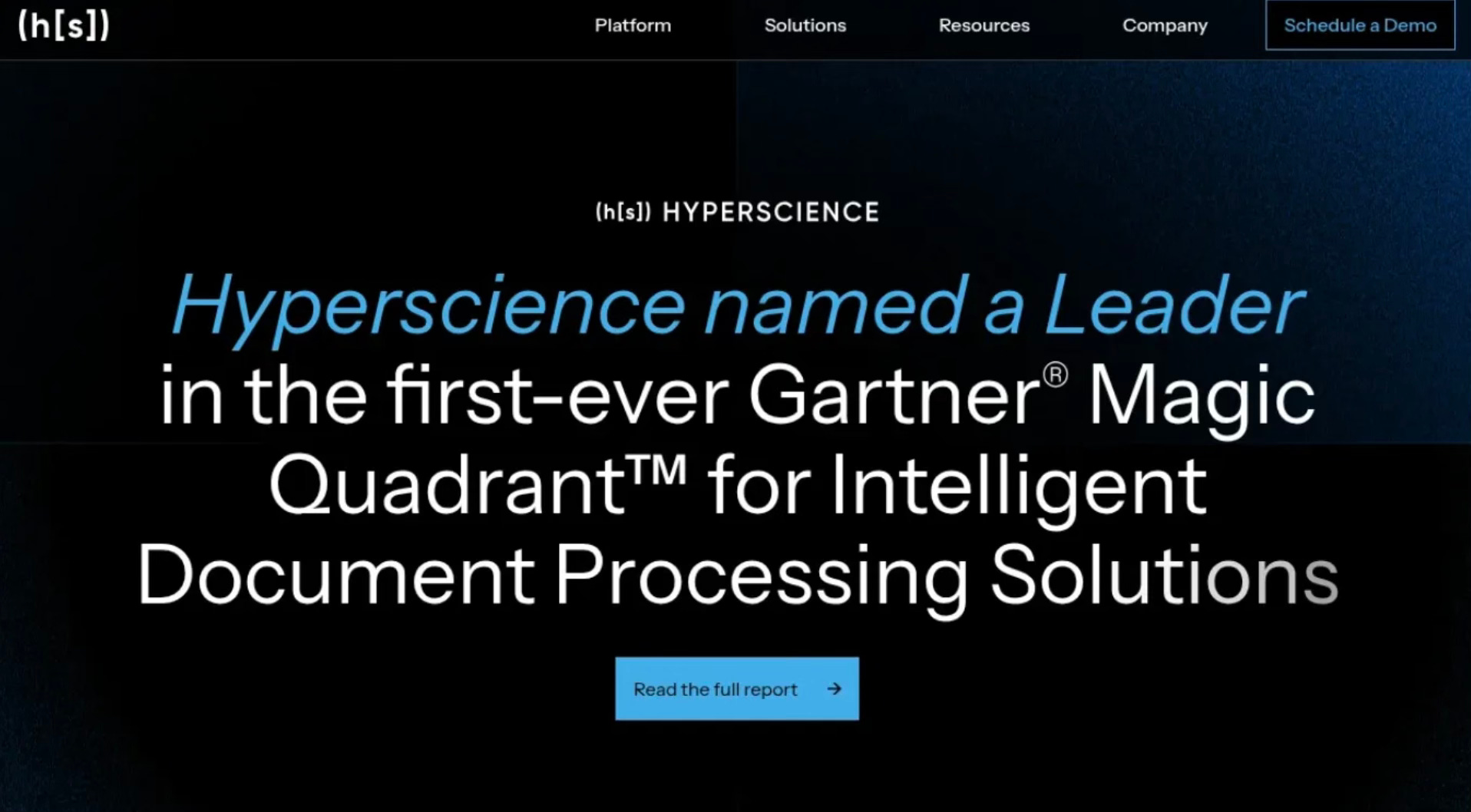
Hyperscience provides advanced document automation solutions designed for high-volume processing environments. The company combines OCR and machine learning technologies to extract data from a wide range of document types, including handwritten forms, and is primarily aimed at organizations managing large quantities of similar documents.
What they offer: Machine learning models for document classification and data extraction, tools for handwritten text recognition, capabilities for large-scale batch processing, and seamless integration with enterprise systems. The platform performs exceptionally well for standardized, repetitive document workflows, making it a strong fit for sectors such as banking and insurance, where document volumes are high but layouts remain consistent.
Once trained, its machine learning models can adapt to moderate format variations.
However, the solution’s high implementation costs and technical complexity make it best suited for large enterprises with the resources and scale to support such infrastructure.
4. Tungsten Automation
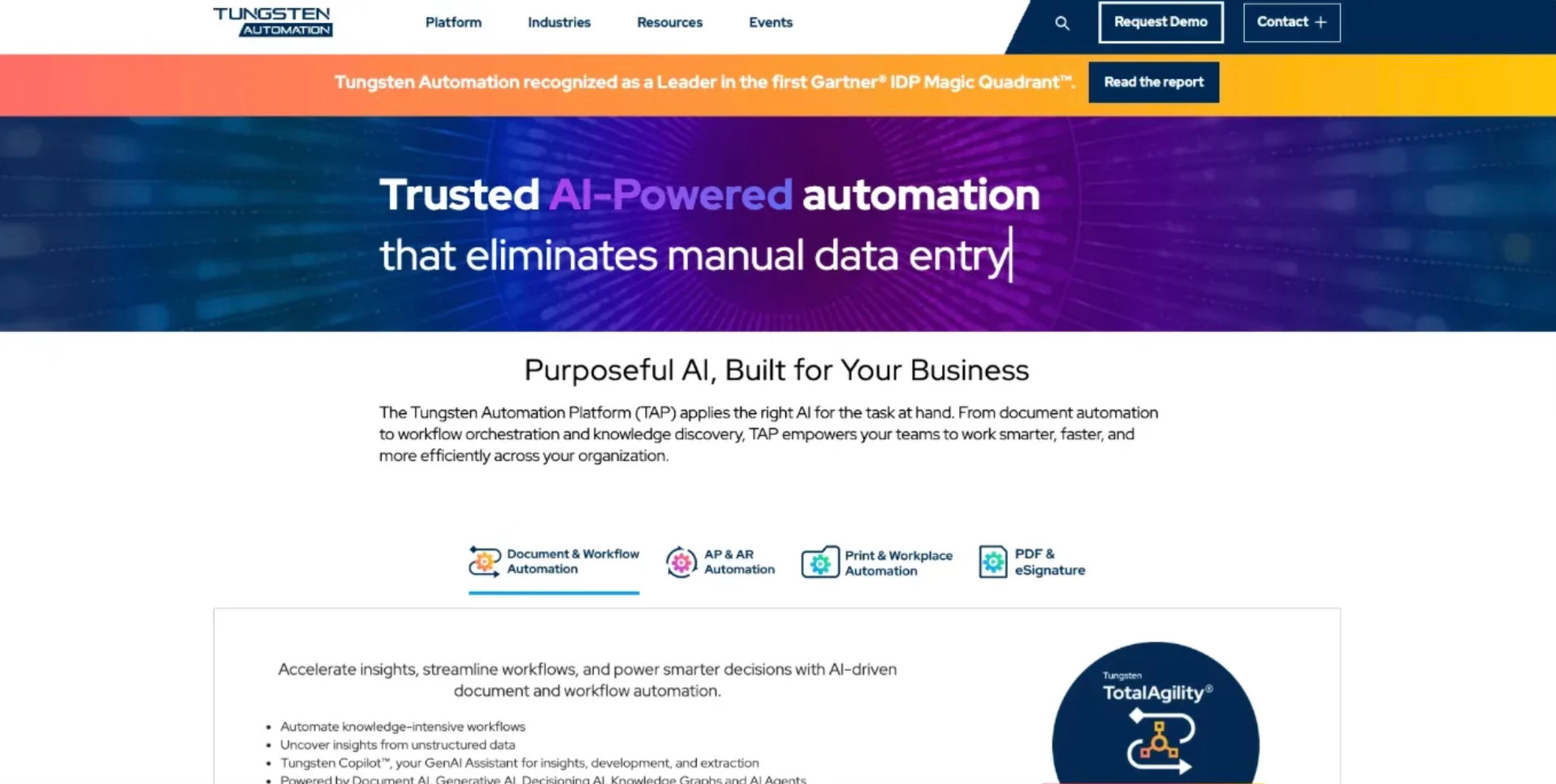
Tungsten Automation delivers software solutions for document capture and processing, helping businesses manage and extract data from forms and other structured documents. The company provides tools for scanning, data extraction, and end-to-end workflow management designed for organizations with established document processing operations.
What they offer: Document capture from multiple input channels, data extraction through template-driven methods, automated document routing, and integration with existing enterprise systems and repositories.The solution performs reliably for companies dealing with consistent document formats and standardized workflows.
With decades of presence in the market, Tungsten has built a strong reputation in traditional document management and capture environments.
However, the platform’s legacy architecture struggles to meet the demands of modern, AI-driven document processing. Its template-based configuration requires significant setup for every new document type, and maintaining these templates becomes increasingly time-consuming as document variations grow.
5. Nanonets
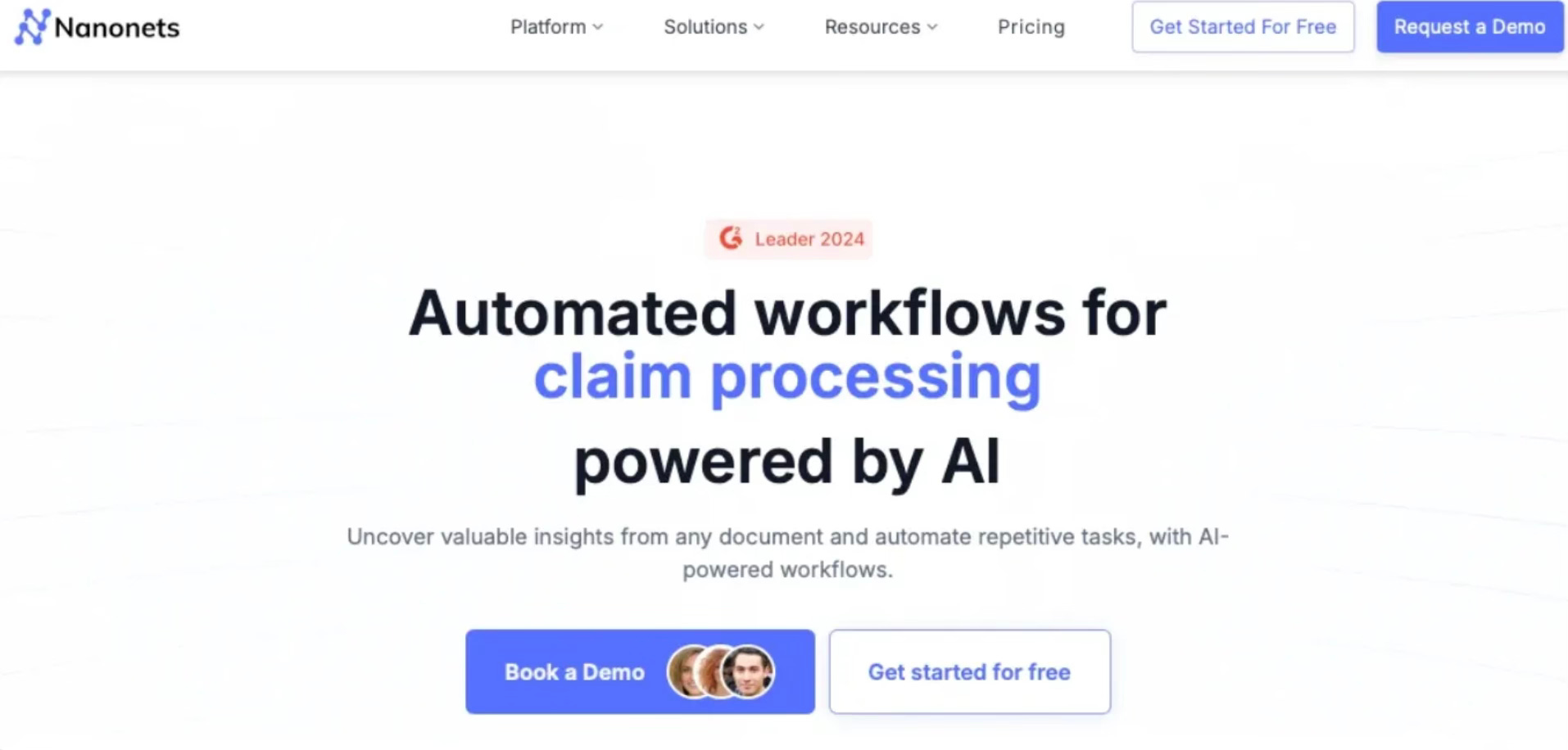
Nanonets delivers an AI-powered document automation platform that uses machine learning and OCR to extract information from invoices, receipts, and other business documents. Designed to minimize manual data entry, it helps automate repetitive back-office processes by transforming unstructured inputs into structured data.
What they offer: tools that combine OCR and machine learning for automated data capture, pre-trained models for standard document types like invoices and receipts, API connectivity for easy integration into existing applications, and basic workflow automation features to streamline document handling.
While effective for predictable layouts and well-structured documents, performance tends to decline with complex formats, handwritten text, or degraded scans. The models are trained on fixed datasets, accuracy can vary between document batches, often requiring manual verification to maintain consistency — a limitation that reduces efficiency in high-stakes or large-scale document environments.
6. Amazon Textract
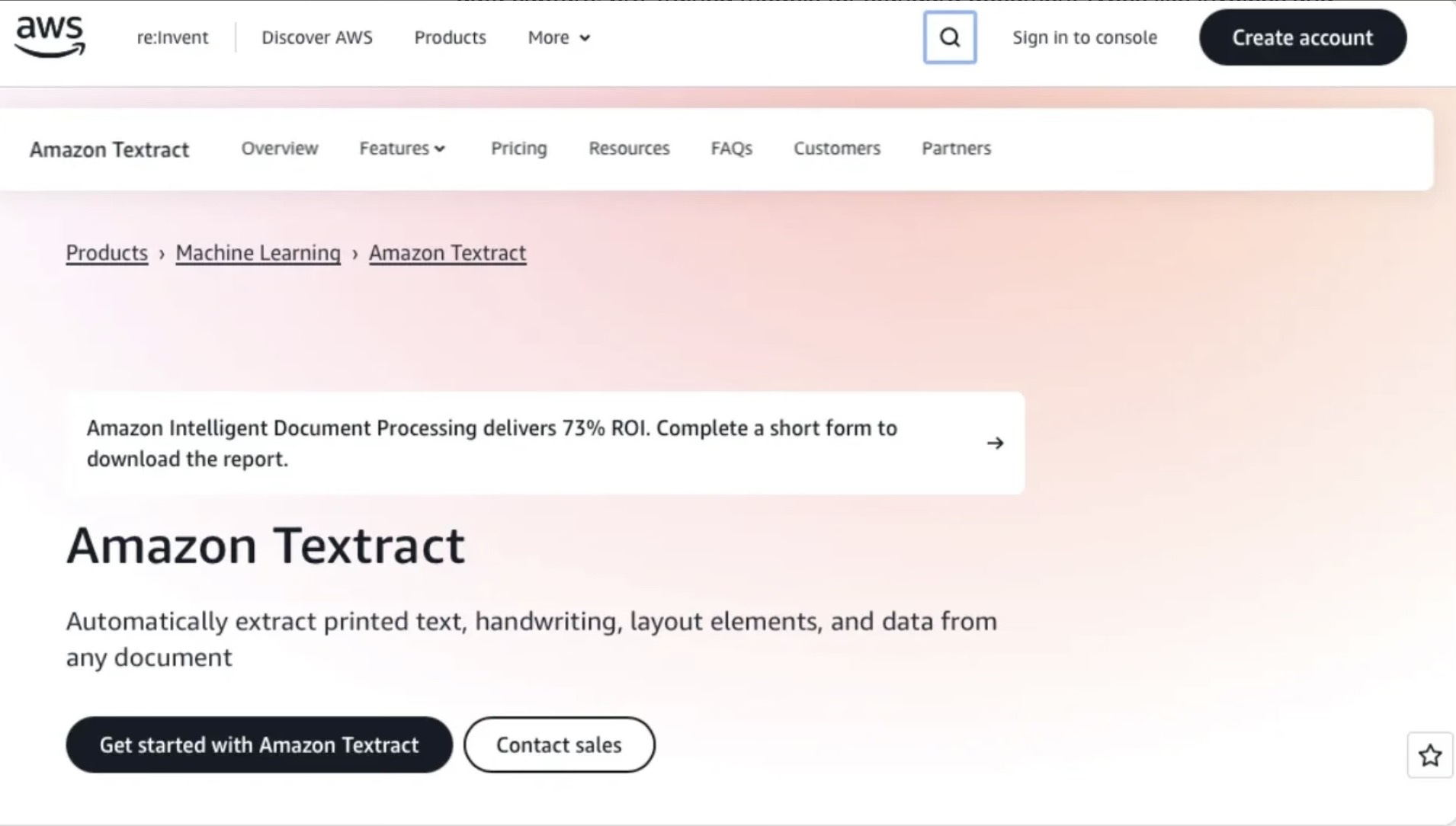
Amazon Textract is a cloud-based document extraction service within the AWS ecosystem, designed to convert scanned documents, forms, and tables into usable digital data. Using machine learning models, it identifies text and structured information and delivers them through a pay-as-you-go API that developers can embed into their own applications for straightforward data-capture tasks.
What they offer: capabilities for detecting and extracting text from images and documents, identifying tables and form fields, and leveraging native integration with AWS tools for cloud storage, analytics, or automation. The platform scales automatically with document volume, providing flexibility for varying workloads.
However, Textract’s functionality remains limited to surface-level extraction. It lacks the contextual understandingrequired to process unstructured or irregular documents and does not include features such as workflow orchestration, human-review modules, or continuous learning mechanisms to improve performance over time. Because its customization capabilities are minimal, teams cannot fine-tune extraction rules for specific formats or business logic, reducing its effectiveness for specialized, high-accuracy document workflows.
Adaptive Document Intelligence with Retab
Most document systems were designed for stability — yet in reality, nothing stays fixed. Formats shift, scans lose quality, handwriting varies, and meaning changes with context. Retab was built for that constant evolution.
It interprets documents as dynamic sources of information — full of structure, nuance, and noise — and organizes them intelligently without relying on rigid templates. Every correction or interaction strengthens its understanding, allowing the system to recognize patterns where others see errors.
The real leap in document intelligence isn’t about processing more files — it’s about understanding them more deeply. Retab brings that clarity to a stage of enterprise workflows that has long resisted automation, turning variability into insight and complexity into consistent, reliable data.
FAQs
How does AI-driven data extraction handle real-world document variability?
AI-native extraction systems are designed for the messy reality of business documents — shifting layouts, handwritten notes, mixed languages, and degraded scans. Unlike rigid OCR tools, they use Large Language Models (LLMs) and Vision-Language Models (VLMs) to interpret structure and meaning contextually. This enables consistent, human-level accuracy across formats without templates, scripts, or constant manual tuning.
What role does continuous learning play in improving extraction accuracy?
Continuous learning ensures that each interaction — every correction or validation — makes the system smarter. Instead of degrading over time, an adaptive platform refines its understanding with every dataset processed. This self-optimizing feedback loop eliminates repetitive errors, maintains high accuracy, and significantly reduces human review.
How do organizations measure ROI when upgrading to intelligent document processing?
ROI comes from both speed and scalability. Teams move from months of setup to days of deployment, while operational costs drop thanks to fewer manual interventions and faster data availability. Companies also gain better compliance visibility and unlock automation across workflows by feeding clean, structured data directly into ERP and analytics systems.
To Keep in Mind When Choosing an Intelligent Document Processing Platform
The evolution of data extraction marks a shift from reading documents to understanding them.
Among this new generation of AI-native solutions, Retab stands out for its adaptive architecture, consensus engine, and continuous learning pipeline — designed to evolve with your business, not against it.
It transforms document variability into structured clarity, delivering production-ready automation that grows smarter, faster, and more reliable with every iteration.